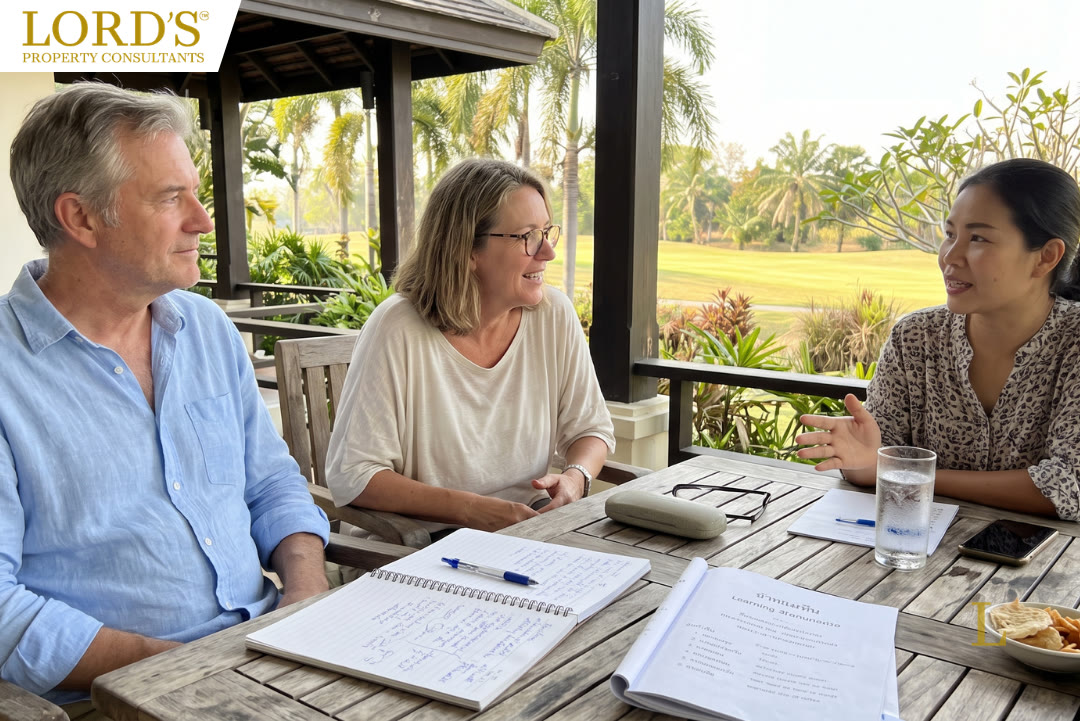
Learning Thai in Hua Hin: Schools, Costs and How Far You Actually Get
Learning Thai in Hua Hin costs 3,100 THB for a 20-hour group block at Sirada, and from about 5,000 THB for a 20-hour group block at Insight, up to 30,000 THB for a full year of classes with an Education visa. Around 135 class hours gets you comfortable everyday Thai. Professional working Thai takes about 1,012 class hours, so set your goal before you choose a school.
Below you will find the schools that actually teach Thai in Hua Hin, what each format costs, how the hours translate into real ability, and how much Thai you need once you own a home here.
Key numbers
1,012 class hours: the US Foreign Service Institute estimate for professional working Thai
3,100 THB: Sirada’s published price for a 20-hour group block
250 to 675 THB per hour: Insight group to private lesson rates
30,000 THB: a one-year Thai course package with Education (ED) visa support
1,900 THB: the standard fee for each stay extension at Immigration
How long does it take to learn Thai?
A native English speaker needs about 44 weeks, or 1,012 class hours, to reach professional working Thai, according to the US Foreign Service Institute. Everyday survival Thai takes a small fraction of that, typically 100 to 150 focused hours.
The Foreign Service Institute language learning timelines place Thai in Category III, the hard languages with significant linguistic and cultural differences from English. That puts Thai alongside Vietnamese, Khmer and Russian. Japanese, Korean and Mandarin sit in the hardest category, at 2,200 class hours.
The 1,012-hour figure is the time usually expected to reach an integrated score of 3 in speaking and listening on the Interagency Language Roundtable scale, the level a diplomat needs to work in the language. A typical week at the Institute is 23 class hours, plus self-study. Few people living in Hua Hin study at that pace, and few need to.
Three features make Thai slow at the start. Thai has five tones, so the same syllable can carry several unrelated meanings. Thai script has its own alphabet with no spaces between words. And spoken Thai uses polite particles and levels of formality that textbooks often underplay. Once those foundations are in place, grammar is simple: no verb conjugation, no plurals, no gendered nouns.
Which Thai language schools are in Hua Hin?
Hua Hin has three established places to study Thai: Insight Hua Hin (group, semi-private and private classes plus ED visa packages), Sirada The Learning Centre (a Ministry of Education approved Thai curriculum) and ILC Hua Hin (private one-to-one coaching based on the Chulalongkorn University programme).
Insight Hua Hin has taught languages in Thailand since 2004 and runs its Hua Hin school at The Sunset, 155/28 Nong Kae. Its Thai programme has three 45-hour levels: Everyday Thai One (greetings, food, directions, time), Everyday Thai Two (banking, appointments, phone calls, opinions) and a reading and writing level that moves you off transliteration and onto Thai script. Group classes meet twice a week.
Sirada The Learning Centre sits in the centre of town, on the second floor of 83/14 Wongchomsin Building, Phetkasem Road, a few minutes’ walk from Hua Hin Municipality. Its Thai curriculum is approved by the Ministry of Education and covers speaking, listening, reading and writing across Beginner, Intermediate and Advanced levels. Classes are taught in Thai and English, mainly as groups, with private sessions by arrangement. A published group block is 20 hours, taught as ten lessons of two hours, on Monday and Wednesday or Tuesday and Thursday. If you are weighing up living in Hua Hin town centre, both Sirada and the main language schools are within easy reach.
ILC Hua Hin (International Language Centre), at 39/20 Soi Mooban Khaonoi, offers private Thai coaching that follows the nine-level programme and materials of the Centre for Thai as a Foreign Language at Chulalongkorn University. ILC also lists Thailand Education Visa programmes. One-to-one coaching suits owners on golf estates outside town who prefer a fixed weekly slot.
Private tutors are the fourth option. Freelance Thai teachers in Hua Hin advertise on tutoring marketplaces, often teaching at your home or online. Quality varies widely, so ask for a free trial lesson and a written lesson plan before you commit.
How much do Thai lessons cost in Hua Hin?
Sirada publishes a group block at 3,100 THB for 20 hours. Insight quotes 250 THB per hour in a group class, 350 THB per person semi-private and 675 THB per hour private. Year-long Thai packages with ED visa support cost 30,000 THB at Insight, and freelance tutors advertise from about 300 to 350 THB per hour.
The table compares the main formats. Insight publishes the ED package prices on its site. The hourly Insight rates are the 2026 figures used for this comparison. Sirada publishes its group price.
Option
Format
Price
ED visa support
Best for
Insight ED package
Group, 2 lessons a week
16,500 THB (6 months) 30,000 THB (1 year)
Yes
Long stays before retirement age
Insight group block
Group class
250 THB/hour 5,000 THB per 20 hours
No
Budget learners with a visa already
Insight semi-private
2 to 3 people
350 THB/hour per person 7,000 THB per 20 hours
No
Couples learning together
Insight private
One-to-one
675 THB/hour 13,500 THB per 20 hours
No
Fast progress, flexible times
Sirada Learning Centre
Group, private by arrangement
3,100 THB per 20 hours
Ask the school
Reading and writing from day one
ILC Hua Hin
Private coaching
On request
ED programmes listed
Structured, university-based syllabus
Freelance tutor
At home or online
From about 300 to 350 THB/hour
No
Conversation practice
Prices checked in October 2026. Confirm directly with the school before enrolling.
Budget for the visa side too if you study on an ED visa. Each extension of stay at Immigration carries a standard fee of 1,900 THB, and an ED visa is normally extended in 90-day blocks. Over a year, extensions alone add several thousand baht on top of tuition. For context on how lesson fees fit into a household budget, see our breakdown of the real cost of living in Thailand.
How far do you get with two lessons a week?
Two lessons a week typically adds up to 100 to 150 class hours a year, which is roughly 10 to 15 percent of the 1,012 hours for professional Thai. That is enough to handle shops, restaurants, directions, simple phone calls and polite small talk, but not contracts or complex conversations.
Insight’s three levels total 135 hours, and the course outlines show what that buys: greetings, ordering food, directions and telling the time after the first 45 hours, then banking, appointments, phone calls and opinions after 90 hours, then reading Thai script after 135. That matches what most residents report. After a year of part-time classes you can live your daily life in Thai. You will still lose the thread when two Thais talk quickly to each other.
Practice between lessons matters more than the class count. Use the market, the gardener, village security and the golf course as your homework. If you play, learning a few phrases also makes the round friendlier. Our guide to caddie etiquette and tipping on Thai golf courses explains why a little Thai goes a long way there.
From my experience
The owners I see get the most out of lessons are rarely the ones chasing fluency. They pick a narrow goal, such as numbers, polite endings and the words for the jobs around the house, and use them the same week with people they already deal with. Two lessons a week is plenty for that, as long as the practice happens at the fruit stall and not only in the textbook.
Can you get an ED visa or DTV by studying Thai in Hua Hin?
Yes. A Thai language course at an accredited school can support a Non-Immigrant ED visa, extended in 90-day blocks for up to a year. Embassies set minimum study hours, and a Thai course is not a dependable route to the Destination Thailand Visa (DTV).
The school applies to the Ministry of Education on your behalf, which takes about three weeks at Insight Hua Hin. You then use the approval letter to apply for the visa, and later extensions are handled at Hua Hin Immigration without border runs.
Check the hours before you pay. The Royal Thai Embassy in Singapore ED visa requirements, updated 18 May 2026, state that a Thai language course of up to five months must run at least four days a week, two hours a day, and a longer course at least five days a week, five hours a day. Requirements differ between embassies and for applications made inside Thailand, but a twice-weekly schedule may not satisfy every consulate. Ask the school, in writing, how its timetable meets the rules of the embassy you will apply through.
Avoid any school that tells you attendance is optional. Immigration expects regular attendance and school confirmation at each extension, and visa-only enrolments have been a long-standing target of enforcement.
The DTV soft-power route is better known for Muay Thai and cooking courses. Some applicants report embassies accepting Thai language classes, others report refusals, so treat it as uncertain. For a longer-term plan, compare the options in our guide to visas for living year-round in Hua Hin, and if you plan to buy, read which visa you need to buy property in Thailand.
How much Thai do you need as a property owner in Hua Hin?
As a Hua Hin property owner you need enough Thai for daily dealings with village security, staff, contractors, neighbours and the juristic office. Anything legal, from Land Office transfers to contracts, still needs a qualified translator or agent, however good your Thai becomes.
Day-to-day ownership runs in Thai. Juristic office notices, utility bills and village rules are often posted in Thai first. Your gardener, maid and pool cleaner may speak little English, and clear instructions save time and money. See our guide to maid, gardener and pool cleaner costs in Hua Hin for what those roles involve. Questions about common area charges also go more smoothly when you can follow the discussion. Our explainer on HOA and CAM fees in Hua Hin covers what you are paying for.
When I hand over keys, I tell buyers the same thing: learn the numbers and the polite endings before anything else. Prices, house numbers, meter readings and quotes all come down to numbers, and ending a sentence with khrap or kha changes the tone of every conversation with security, staff and the juristic office. Where I draw a hard line is paperwork. Anything for the Land Office or in a contract goes through a qualified translator, no matter how confident your Thai has become.
A useful first-month list for new owners: numbers to 1,000, days and times, the polite particles, your address and village name, the words for water, electricity, leak, broken and repair, and how to ask how much and when. That set covers most of the conversations an owner has in the first year.
Frequently asked questions
Do I need to learn to read Thai script?
You can speak basic Thai without reading it, but script makes tones and pronunciation far easier to learn than transliteration. Most schools introduce reading after the first 90 hours of spoken Thai.
Is Thai harder to learn than Japanese or Chinese?
The US Foreign Service Institute rates Thai at about 1,012 class hours. Japanese, Korean and Mandarin take 2,200 hours. Thai grammar is simple. The tones and script take the most effort.
Can I learn Thai online while living in Hua Hin?
Yes. Online tutors and Hua Hin schools offering online classes are a cheaper and more flexible option. An online-only course is less likely to support an ED visa, so check before enrolling if the visa matters.
Do people in Hua Hin speak English?
English is common in hotels, malls, hospitals and the main tourist streets. Outside those areas, including markets, village offices and trades, basic Thai makes daily life noticeably easier.
How much does a one-year Thai course with an ED visa cost in Hua Hin?
A one-year Thai package with ED visa support costs 30,000 THB at Insight Hua Hin, or 16,500 THB for six months. Add the visa fee and 1,900 THB for each 90-day extension of stay.
Is a private tutor better than a group class?
Private lessons give you more speaking time and tone correction, so progress per hour is faster. Group classes cost roughly a third as much per hour and add structure, which suits learners who need a fixed routine.
Conclusion: set a goal, then pick the format
Learning Thai in Hua Hin is affordable and practical if you match the course to the goal. For daily life as an owner or long-stay resident, a year of part-time classes, around 100 to 150 hours, gets you comfortable with shops, staff, neighbours and the juristic office. Choose a group package if you also need an ED visa, private lessons if you want speed, and keep a translator for anything legal.