Do You Need a Golf Cart in a Hua Hin Golf Community? Rules, Prices and Storage
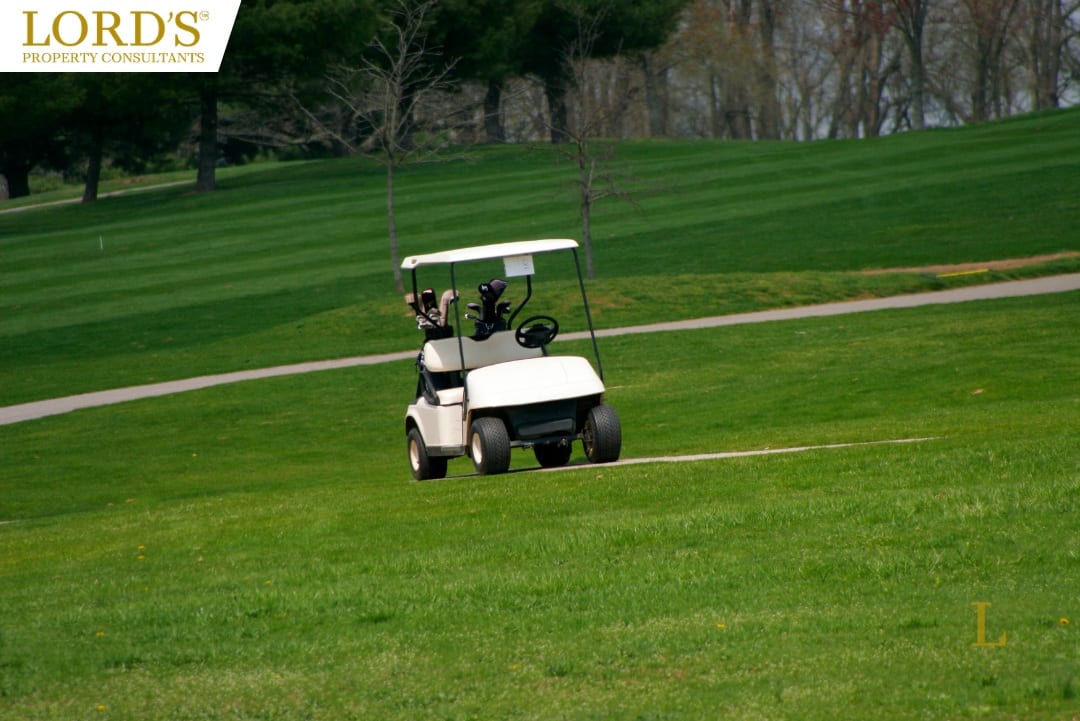
For most owners in a Hua Hin golf community, a golf cart is a convenience rather than a necessity. Thai law keeps unregistered carts off public roads, and the main courses supply a club cart and caddie with every round, so a private cart only earns its place on the roads inside your estate.
That still leaves plenty of owners who use one every day: for the run to the clubhouse, the gym or a neighbour’s villa on a hillside estate. Below I cover what the law allows, what a cart really costs in Thailand, and where to keep and charge it, so you can decide before you spend six figures in baht. If you are still weighing whether you need any vehicle at all, start with living on a Hua Hin golf estate without a car.
Key facts at a glance
Golf carts cannot be registered in Thailand, so they are not legal on public roads.
Compulsory Por Ror Bor insurance still applies to electric carts.
Black Mountain and Palm Hills assign a club cart and caddie to every golfer, so your own cart stays off the course.
New four-seat electric carts from Thai dealers start around 219,000 THB before VAT.
Do you actually need a golf cart if you live in a Hua Hin golf community?
You need one only if your daily trips inside the estate are too long or too steep to walk comfortably. If the clubhouse, pool and gym are a few minutes on foot, or the estate runs a shuttle, a private cart usually sits unused under the carport.
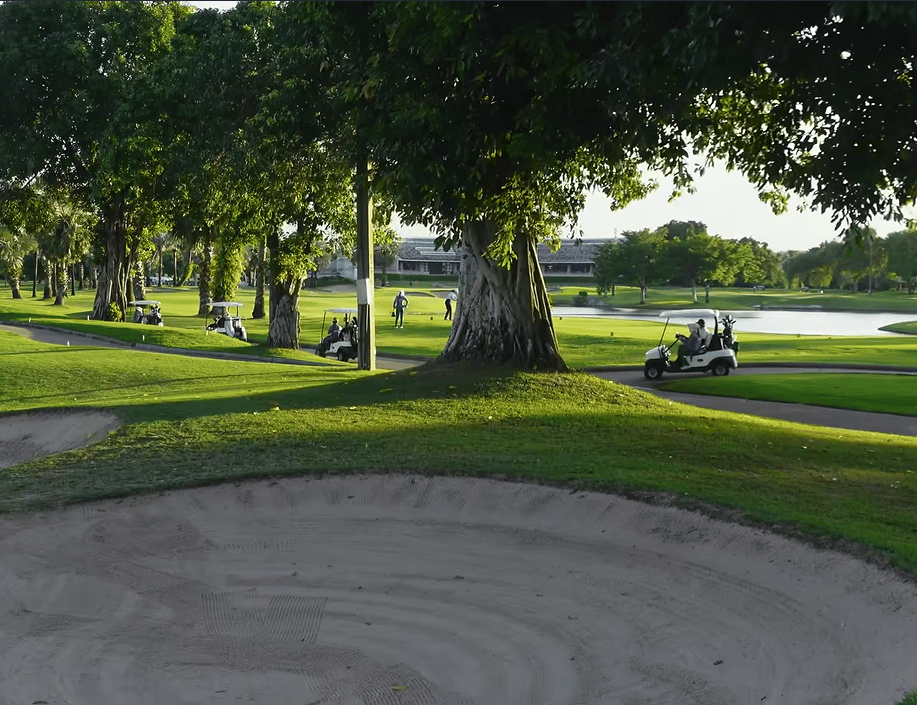
Three things decide it: plot position, terrain and household. Hua Hin’s golf communities range from compact villa rows beside the clubhouse to large foothill estates west of town where plots climb away from the facilities. Some developments, such as Banyan Residences, also include a shuttle to the course, which removes most of the reason to own a cart. Our Pineapple Valley and Banyan property guide covers how those two areas are laid out.
When I walk buyers through an estate, I ask them to time the walk from the villa to the clubhouse at midday rather than in the cool of the morning. A route that feels easy at 8 am can be a real effort in April heat, and that simple test tells most buyers whether a cart belongs on their shopping list. Buyers with grandchildren visiting, or anyone who struggles with slopes, usually end up using a cart far more than they expected. Couples on a flat plot close to the clubhouse rarely do.
Can you drive a golf cart on public roads in Thailand?
No. Section 7 of Thailand’s Road Traffic Act forbids using any vehicle on the road without registration plates, and golf carts cannot be registered with the Department of Land Transport. Driving one on Phetkasem Road, or down the soi to the nearest 7-Eleven, is an offence.
Under the Road Traffic Act B.E. 2522 published by the Royal Thai Police, Section 152 sets the fine for breaching Section 7 at up to 1,000 THB. The fine is the small risk. The larger one is an accident on a public road in a vehicle that has no registration and no place in traffic, where liability questions quickly become expensive.
Enforcement varies from place to place, and you will see carts on quiet village lanes. That tells you what local police tolerate on a given day, not what the law permits.
What counts as a road inside a gated estate?
An estate road is private ground only while the owner keeps it closed to general traffic. The same Act defines a “path” to include private roads that the owner allows the public to use, so an estate road that works as an open shortcut can fall under traffic law.
A fully gated estate with a staffed entrance is the clearest case of private ground. Open village roads, or estates whose internal roads link two public streets, are less clear. The estate’s juristic office sets the house rules on carts, speeds and parking, and those rules sit alongside the HOA and CAM fees for Hua Hin golf villas. Ask for them in writing before you buy. Gate control also shapes security, which we cover in are Hua Hin golf estates safe.
Do you need a driving licence or insurance for a golf cart?
Thailand has no separate licence class for golf carts, so no licence is required to drive one on private ground. Insurance is different: compulsory Por Ror Bor cover applies to every vehicle driven by an engine or electric power, whether it is registered or not.
The Office of Insurance Commission’s rules on compulsory motor insurance extend the requirement beyond registered cars and motorcycles to vehicles powered by an engine, electricity or other energy. An electric golf cart fits that description. The owner is responsible for buying the policy, and the law sets a fine of up to 10,000 THB for going without it.
Por Ror Bor covers injury to people, not damage to the cart or to property. For damage to a neighbour’s car or wall, check whether your home policy includes third-party liability, as explained in insuring a golf course villa in Thailand. Many estates add their own rules too, such as a minimum driver age or a ban on unaccompanied children.
Can you use your own golf cart on the course?
At Hua Hin’s main courses, generally not. Black Mountain and Palm Hills assign one caddie and one club cart to each golfer, and at Black Mountain the caddie drives the cart.
Caddies are mandatory at Thai courses, and the club cart comes as part of that arrangement. Black Mountain states that carts cannot be shared because the caddie drives. Palm Hills lists a cart fee of 700 THB and a caddie fee of 350 THB per round, and does not allow cart sharing either. Your private cart takes you to the clubhouse, and the club’s cart takes you round the course. For what to expect from your caddie, see caddie culture, etiquette and tipping on Thai golf courses.
Owning a villa on the course can change your green fees, but it rarely removes caddie or cart charges. Black Mountain offers lifetime membership with a property purchase. Other estates work differently, as covered in do you get free golf if you buy a villa on a Hua Hin golf course.
How much does a golf cart cost in Thailand?
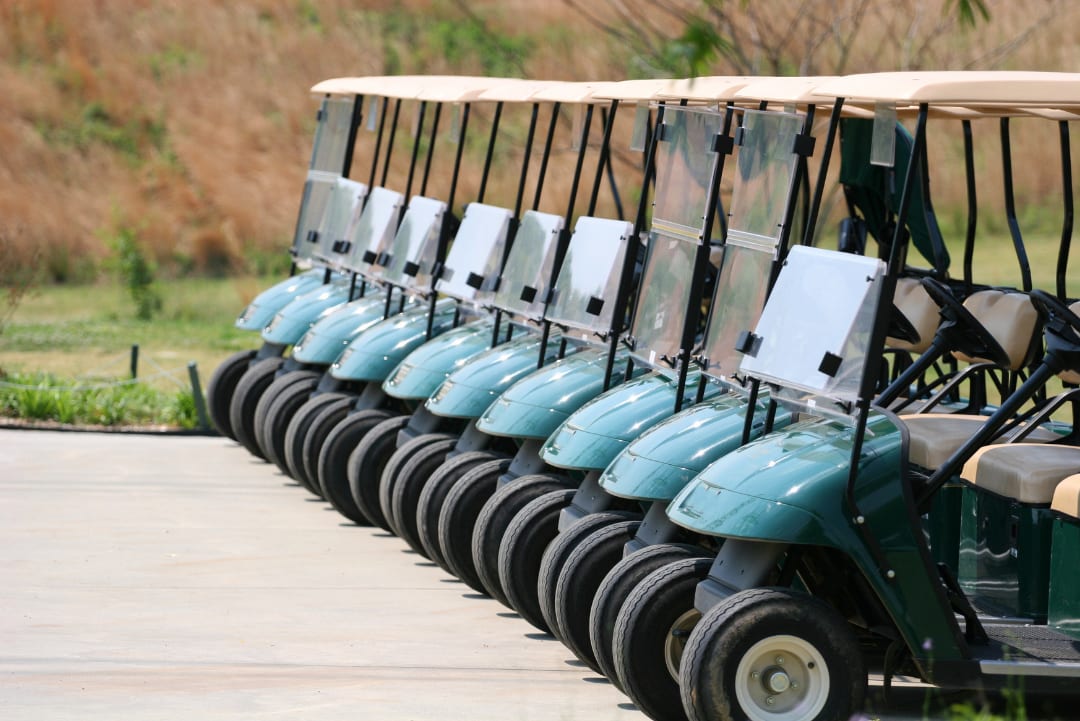
New four-seat electric golf carts from established Thai dealers start at around 219,000 to 299,000 THB before 7% VAT. Budget mini four-seaters are listed from roughly 79,900 THB.
The gap reflects build quality, motor, battery type and after-sales service. The budget models are lighter vehicles suited to short, flat runs. Full-size carts from established dealers come with lithium battery options, stronger suspension for hillside estates and service networks that reach Hua Hin. Add delivery from Bangkok, a charger point at the villa and Por Ror Bor to your budget.
Option
Typical price (THB)
Best suited to
Budget mini 4-seater
From about 79,900 to 84,900
Short trips on flat estates, occasional use
Standard 2-seater
209,000 to 225,000 + VAT
Couples, daily clubhouse runs
Standard 4-seater
219,000 to 299,000 + VAT
Owners with guests, hillside plots
Standard 6-seater
229,000 to 309,000 + VAT
Families and regular hosting
Club cart on course (Palm Hills)
700 per round
Required for play, whether you own a cart or not
Prices are 2026 list prices from Thai dealers and course rate cards. Confirm current pricing and delivery to Hua Hin before ordering.
Since the club cart is charged per round whether you own a cart or not, a private cart never “pays for itself” through golf. Compare it instead with the cost and hassle of driving a car or calling a taxi for every short trip inside the estate.
Where do you store and charge a golf cart in a Hua Hin villa?
Keep the cart under a solid roof, off wet ground, and charge it from a dedicated, earthed outlet rather than an extension cable. Before you buy, confirm where your estate allows carts to be parked and charged, because the juristic office sets those rules.
The monsoon months are the real test. Driving rain, standing water and high humidity work on electrics, seats and battery terminals, so a carport open on three sides is the minimum and a closed garage bay is better. Our guide to Hua Hin golf estates in the rainy season explains what the wettest months look like on the ground. On frontline plots, park the cart out of the line of play, for the reasons covered in living next to a fairway in Hua Hin.
The mistake I see most often is buying the cart first and planning where it lives afterwards. Many villas have a carport sized for one car, and once the family car is in, the cart ends up on the lawn in the rain or blocking the driveway. When I show a villa to a buyer who wants a cart, I measure the carport with them and check where the nearest outlet is. Adding a covered bay and a proper outlet during the purchase or renovation is far cheaper than fixing it later.
Battery choice affects storage too. Lead-acid batteries need regular water top-ups and a ventilated space while charging. Lithium batteries cost more but are lighter, need no topping up and cope better with long periods of disuse, which suits owners who spend part of the year abroad.
Buy, rent or skip it: which option fits your property?
Buy a cart if you live on a large or hilly estate year-round. Skip it if your villa is a short, flat walk from the clubhouse or your estate runs a shuttle.
Frontline villa beside the clubhouse: skip it. Walking is quicker than finding somewhere to park.
Hillside plot on a large foothill estate: buy a two or four-seat cart with a lithium battery and good suspension.
Part-time owner: consider a budget model, or arrange a seasonal rental for the months you are here. The best months to play golf in Hua Hin are also when most part-time owners arrive.
Estate with an owners’ shuttle: skip it unless mobility is an issue for someone in the household.
Frequently asked questions
Can I drive my golf cart to a shop outside the estate gate?
No. Once you pass the gate you are on a public road, and an unregistered cart is not allowed there under Section 7 of the Road Traffic Act.
Can children drive a golf cart inside a gated estate?
Thai law has no golf cart licence, but many estates set a minimum driver age in their house rules. Even where it is allowed, an adult should supervise, since carts reach around 25 km/h and have no seat belts or doors.
Is a lithium or lead-acid battery better in Thailand’s climate?
Lithium costs more upfront but is lighter, needs no water top-ups and tolerates months of storage. Lead-acid is cheaper to buy but needs regular maintenance and a ventilated place to charge.
How far does an electric golf cart go on one charge?
Most electric carts cover roughly 50 to 100 km per charge, depending on the battery and terrain. That is far more than a typical day of trips inside a Hua Hin estate.
Do I pay annual road tax on a golf cart?
No. A golf cart cannot be registered, so there is no annual vehicle tax, but compulsory Por Ror Bor insurance still applies.
Does buying a golf villa include free use of the club’s carts?
Rarely. Membership terms vary by estate, but caddie and cart fees are usually charged per round even for owners with membership.
Conclusion: is a golf cart worth it in a Hua Hin golf community?
A golf cart is worth buying when your villa sits far from the clubhouse or up a slope, when you live in Hua Hin most of the year, and when you have a covered, powered space to keep it. It is not a way to save on golf, because the courses charge for their own carts and caddies every round, and it is never a way around the road rules beyond the gate.
Settle the practical questions before you choose the villa: walking distance to the facilities, estate rules on carts, and carport space. If you are comparing golf estates now, I am happy to walk the routes with you on site. The process of buying property in Thailand as a foreigner explains the next steps once you have found the right one.